Security Is Not an Afterthought
Bolting security onto a finished product is like installing a fire alarm after the building has already burned down. The time to invest is before the breach, when you still have something to protect.
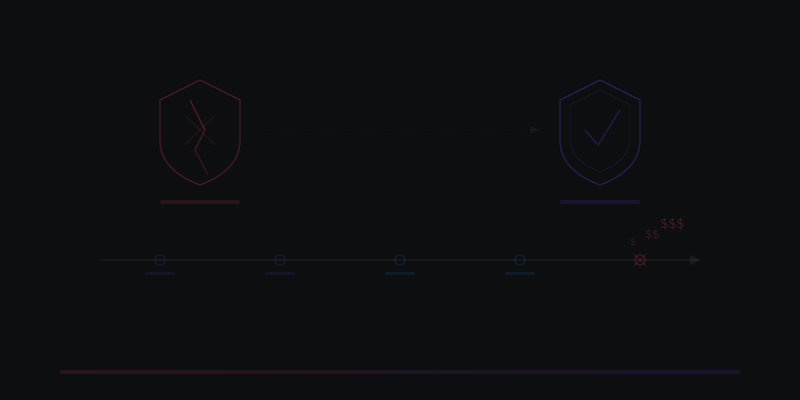
Security Is Not an Afterthought
Build It In or Pay for It Later
The Real Cost of Waiting:
IBM's 2024 Cost of a Data Breach report puts the global average at $4.88 million per incident. For small businesses under 500 employees, the number is lower in absolute terms but often fatal in proportion: the average breach costs between $120,000 and $1.24 million, and 60% of small businesses close within six months of a significant breach. These numbers include direct costs like forensic investigation, legal fees, regulatory fines, and customer notification. They do not include the harder-to-measure damage: lost customer trust, destroyed reputation, and the months of operational disruption while you rebuild. A single ransomware attack can lock you out of your own systems for weeks.
Most of these breaches are preventable. Not with exotic technology, but with basic practices that were skipped because security was treated as a phase to bolt on later rather than a foundation to build on from the start. The breached company typically had no dependency scanning, no secrets management, no infrastructure hardening, and no incident response plan. They spent their budget on features and figured they would get to security after launch. After launch never came.
Security by Design vs. Bolt-On Security:
Bolt-on security is what happens when a product ships first and someone asks about security second. It looks like running a penetration test on a finished application and discovering that the authentication system stores passwords in plaintext, the API has no rate limiting, and the database is directly accessible from the public internet. At that point, fixing these issues means rewriting core systems under pressure, often while simultaneously dealing with the vulnerability they created. It is expensive, slow, and demoralizing for the team. Security by design means making security decisions at the architecture stage, before a single line of code is written.
Shift-left security is not a buzzword; it is a cost equation. Finding and fixing a security flaw during development costs roughly 6x less than fixing it in production. During the design phase, it costs nearly nothing: you just make a different architectural choice. In production, after customer data has been exposed, it costs everything. This means threat modeling during architecture reviews. It means choosing secure defaults: HTTPS everywhere, least-privilege IAM policies, encrypted storage from day one. It means selecting dependencies with known security track records and monitoring them for vulnerabilities continuously.
Practices That Make Security Automatic:
The goal is to make security invisible to developers by embedding it into the tools they already use. Run Dependabot, Snyk, or Renovate to automatically flag vulnerable dependencies in pull requests before they merge. Use git-secrets or gitleaks in pre-commit hooks to prevent API keys, database credentials, and tokens from ever reaching your repository. Manage secrets through a dedicated system like HashiCorp Vault, AWS Secrets Manager, or Doppler; never store them in environment files committed to source control. Harden your infrastructure with IaC tools like Terraform or Pulumi so that security configurations are versioned, reviewed, and reproducible.
Run SAST (static analysis) in your CI pipeline with tools like Semgrep or CodeQL. These catch common vulnerability patterns: SQL injection, XSS, insecure deserialization, and hardcoded credentials before the code reaches a reviewer. Add DAST (dynamic analysis) in staging environments to test running applications for runtime vulnerabilities. Set up container scanning for Docker images. None of these tools are perfect, but layered together they create a safety net that catches the majority of common mistakes before they reach production.
Start Now, Not After the Breach:
If you are reading this and realizing your security posture is mostly reactive, you are not alone. Most small businesses operate this way until something forces their hand. The good news is that starting does not require a massive budget or a dedicated security team. It requires commitment to a handful of non-negotiable practices: enforce MFA everywhere, deploy a password manager, enable dependency scanning in your CI pipeline, move secrets out of code, and write an incident response plan. These five things, done properly, eliminate the majority of attack vectors that affect small businesses.
At MajorLinkx, security is part of every project from the first conversation. We discuss threat models during discovery, build infrastructure with hardened defaults, scan dependencies before they merge, and test for vulnerabilities before deployment. We do this because retrofitting security is painful and expensive, and because our clients trust us with their systems and their customers' data. If your current development process treats security as someone else's problem or a future milestone, change that today. The breach is not going to wait for you to get around to it.